Fall 2025
About the Toolkit
This toolkit grew out of a need to build evidence and document the ongoing practices, policies, and programs aimed at stopping violence in within Asian American, Native Hawaiian, Pacific Islander (AANHPI) and Middle Eastern and North African (MENA) communities. To address this need, API-GBV (Asian Pacific Institute on Gender-Based Violence) collaborated with researchers from two Midwestern universities and held listening sessions with 20 advocates across the country with experience providing primary prevention efforts. API-GBV recruited these advocates through the listserv, word of mouth, and through outreach via listserv for South Asian Survivors, Organizations, and Allies Rising (SOAR). The participating advocates shared the barriers, practices, and successes of their prevention work, including local to state level policy advocacy, program evaluations, leadership cohorts, trauma-informed community healing spaces, and healthy relationship training initiatives.
Many of the resources found in this toolkit were submitted and even developed by the advocates who engaged in these listening sessions, and we thank them for their time, effort, and contributions. This project would not be possible without them. Thank you to AACI (The Asian Americans for Community Involvement of Santa Clara County Inc), API-Chaya, Apna Ghar, American Samoa Alliance against Domestic and Sexual Violence, Center for Asian Pacific Family (CPAF), Arab American Family Services, Narika, An-Nisa Hope Center, Domestic Violence Advocacy Consortium (DVAC) of Santa Clara County, KAN-WIN, Hmong Women’s Association, Asian American for Community Involvement (ATASK), Desi Dance Network, Saahas For Cause, Saheli, and Maitri for participating.
We also acknowledge that due to time constraints and scheduling conflicts, we could not hear from everyone. This toolkit is a living document: if you have rights and access to prevention tools and would like to add them to this compendium, please email research@api-gbv.org or fill out the following form to connect with API-GBV’s research team.
Submit a request or a resource:
For more information about the findings from this project, the full-length report can be found here: Building Prevention Together: Lessons from Advocates on Ending DV/SA in AANHPI and MENA Communities.
What can I find in this toolkit?
This toolkit is designed to support individuals and organizations working within Asian American, Native AANHPI, and MENA communities by offering a range of resources to strengthen and inform primary prevention efforts to end domestic violence, dating violence, sexual assault, and/or stalking. Inside, you’ll find:
-
- Theoretical frameworks to ground prevention work in research and practice;
- Insights and narratives from advocates who are actively implementing prevention strategies;
- Practical methods and techniques for applying primary prevention in culturally relevant and community-driven ways;
- Tools and resources that can be adapted or expanded to fit your unique context.
Our goal is to provide a dynamic, community-informed resource that uplifts promising practices, fosters learning, and encourages connection among those working to prevent domestic violence, dating violence, sexual assault, and/or stalking before it begins.
Who is the toolkit for?
This toolkit is for anyone engaged in or interested in the primary prevention of domestic violence, dating violence, sexual assault, and/or stalking in AANHPI and MENA communities. Whether you’re a seasoned advocate, a program coordinator, a community educator, a policy maker, or just beginning to explore prevention work, this resource is meant to support your journey. We especially welcome contributions from community members and practitioners who are developing and testing new approaches—this is a living toolkit, and we invite you to share what’s working in your community so we can continue to learn and grow together.
Defining Primary Prevention
In the listening sessions, “advocates consistently defined primary prevention as addressing the root causes of violence before it occurs. While aligning with mainstream definitions, particularly the goal of preventing first-time perpetration and victimization, participants emphasized the need for culturally grounded, community-specific approaches. Prevention was described as encompassing education, community-building, and promoting resilience.
Advocates also noted that conventional definitions often overlook cultural nuances and structural inequities, such as racism, immigration policy, and intergenerational trauma. To more effectively serve AANHPI and MENA communities, participants called for an ecological approach to prevention that integrates individual, community, and systemic factors. Successful prevention efforts were characterized by partnerships with community stakeholders, engagement with youth, and tailored messaging.”
Tools for Prevention
Training 101 on Domestic Violence, Dating Violence, & Sexual Assault
Presentation: Preventing Domestic Violence: Changing Norms, Skills, and Environments How do we do it -- What Methods Are Effective?
Slide deck workshop for service providers. Covers the spectrum of prevention, difference between primary, secondary and tertiary prevention, the use of risk and protective factors to do prevention intervention, provides examples of individual, community, institutional and societal level. Provides links to additional resources
Developed by Apna Ghar, a Chicago-based organization working to gender violence. Primarily serving Black, Indigenous People of Color (BIPOC) program participants with 1/3 of program participants being children younger than 19 years. Participants come from 50 different countries and providers speak 20 languages. For more information about the organization, email info@apnaghar.org.
Community Conversations Discussion Guide for Building Safe, Healthy Communities
Guide for a 10-week community intervention program for building healthy, safe and peaceful communities. Facilitator recommendations and an outline of the structure of the program. For more information, reach out to Arab American Family Services.
Developed by Arab America Family Services, an organization working towards the elimination of domestic violence among the Arab and Muslim communities throughout Illinois. They offer both domestic violence and sexual assault prevention programs and intervention services.
Approaches to Filipino Community Engagement in Prevention Research: A Scoping Review*
Scoping review about Filipino American Community Engagement in Prevention Research. 11 studies included. Culturally tailored strategies used in the studies include having bilingual providers, and translated materials, encouraging community involvement, recruitment from culturally significant sites, and integrating cultural values into program design
*For access to this research article, please email research@api-gbv.org and you will receive a password-protected copy of the file. Special thanks to authors Jon Torres, MSW, LICSW and Emiko Tajima, PhD for providing access.
South Asian College Students and Dating Violence
Slide deck presentation/training that invites South Asian students to think about their values regarding intimacy and relationship dynamics, describes research dating violence among college students, provides cultural examples, describes how students can help others. Resources from Apna Ghar and other organizations working with South Asian communities.
Developed by Apna Ghar, a Chicago-based organization working to end gender violence. Primarily serving Black, Indigenous People of Color (BIPOC) program participants with 1/3 of program participants being children younger than 19 years. Participants come from 50 different countries and providers speak 20 languages. For more information about the organization, email info@apnaghar.org.
2024 Youth Workshop: Together We Can End Abuse
Slide deck developed by Apna Ghar for youth leaders’ workshop. Invites young people to reflect on their own values and societal values about relationships. Describes healthy and unhealthy relationships, the teen power and control wheel, teen equality wheel, public harassment. Details individual-level and societal-level action steps and additional community resources.
Developed by Apna Ghar, a Chicago-based organization working to end gender violence. Primarily serving Black, Indigenous People of Color (BIPOC) program participants with 1/3 of program participants being children younger than 19 years. Participants come from 50 different countries and providers speak 20 languages. For more information about the organization, email info@apnaghar.org.
Activity on Healthy Partners for Young People: Cool, Not Cool, WTF
Developed by KAN-WIN, a Chicago-based organization working to eradicate gender-based violence through comprehensive, survivor-centered services, education, and outreach to Asian American communities and beyond.
Peaceful Futures
Provides a youth prevention curriculum called Peaceful Futures. This program is offered to Muslim youth groups or religious leaders working with youth, those having a BA degree in education/mental health, Islamic school staff or teachers. For more information and to request a training, see their training request form.
Developed and provided by Peaceful Families, a national non-profit located in Philadelphia with international reach with a focus on preventing domestic violence and providing training to professionals and organizations serving Muslim families of diverse cultural, ethnic and racial backgrounds. Its programming includes prevention and intervention in its approach to community education and development, training and technical assistance, and research to prevent domestic violence. While not a direct service provider, PFP works with faith and community leaders, community members, social service professionals, activists, educators, mental health providers, medical professionals, attorneys, and youth leaders.
Parenting
Guidance for Immigrant & Refugee Families: Parenting in a New Country
This factsheet explains the difficulties newly arrived immigrant parents may experience while adjusting to living in the United States. Discusses family dynamics, parenting styles, child abuse and neglect, family dynamics, protective factors and community resources.
Raising Young Children in a New Country: Supporting Early Learning and Healthy Development
Raising Young Children in a New Country: Supporting Early Learning and Healthy Development is a parenting resource guide created by BRYCS in collaboration with the Office of Head Start’s National Center on Cultural and Linguistic Responsiveness (NCCLR) for immigrant and refugee parents.
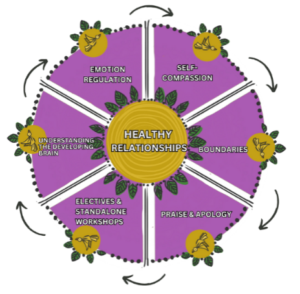
SAPHAL Healthy Relationship Skills Workbook
Koshish: a parenting podcast by Narika
From Our Table to Yours: A Zine on Consent and Boundaries
Booklet about boundaries on an individual, interpersonal, community and societal level. This resource is detailed, visually engaging, easy to read, and culture specific. Topics include personal boundaries, sexual boundaries, time boundaries, indicators of consent, respecting others’ boundaries, reflecting on boundaries on a societal and historical level. Introduces the consent model and wheel of consent
Developed by SOAR (Survivors, Organizations, and Allies Rising), a South Asian collective that serves as a home for the national movement to end gender-based violence in the South Asian diaspora.
One-Pager: Respectful Conversation Starters
Having conversations with young people about respectful relationships. Briefly explains how to have conversations about self-respect, personal boundaries, dating relationships and recognizing abuse. See also Futures Without Violence and love is respect who developed the resource.
Faith Settings
Delivering 'Anti-Bullying' Education to Samoan Churches
Case study of American Samoan community efforts to develop an anti-bullying project. This is a partnership between the department of education, community organizations, and religious organizations. The document describes program activities, educational material, level of engagement, and evaluation of the intervention. Children, youth and parents were included in the intervention
This program was developed by The American Samoa Alliance against Domestic Abuse and Sexual Violence (ASADSV), also known as “the Alliance.” Its mission is to empower all individuals and communities in American Samoa through collaboration, promoting resiliency, and strengthening capacity in addressing domestic and sexual violence.
Peaceful Families Project
Peaceful Families Project offers several programs, including a youth prevention curriculum called Peaceful Futures and a Muslim Male Bystander Intervention to the local Philadelphia as well as nationally. For more information, see their contact information and to request a training, see their training request form.
API Chaya
API Chaya provides direct services to survivors of DV in Seattle, WA and also provides prevention programming and education through its community organizing programs such as the Bonds of Kinship program, Natural Helpers Program, and the Peaceful Families Taskforce (PFT). For more information, see their contact form.
The Bonds of Kinship: Cultivating positive family relationships through skill-building within an Islamic framework is a curriculum developed by API Chaya and Neelam Khaki, the Peaceful Families Taskforce Coordinator. API Chaya reserves the rights to this curriculum. For more information, visit API Chaya’s website or contact their email: info@apichaya.org for permission to reprint.
Community Engagement
Domestic Violence Advocacy Consortium of Santa Clara County Infographic
This infographic incorporates notes from the Domestic Violence Advocacy Consortium (DVAC) of Santa Clara County, featuring an update on its vision, values, and a brief historical account of DVAC agencies, including AACI (The Asian Americans for Community Involvement of Santa Clara County Inc). This timeline details how Bay Area DV, SA, trafficking, and other local organizations addressing violence came to fruition and eventually partnered to meet community needs. Collectively, the nonprofit organizations in DVAC provide coordinated care for survivors and their children, as well as advocate together for survivor defined policies at the local and state levels.
Evaluation
Notes on Evaluation Measures of Desi Dance Network
This document describes how Desi Dance Network measures and evaluates primary prevention sexual violence programs. For instance, trainings are measured using engagement and attendance measures, and participant evaluate the program and their own abilities.
About Desi Dance Network’s violence prevention program: framework and evaluating trainings and workshops
Developed by DDN Inc. (Desi Dance Network), a national organization that fosters a community among South Asian dancers and performance artists with in collegiate and high school dance spaces. For more information about their vision and programs, see their website or reach out via their contact form.
Evaluation For Peer Advocate Leadership Training
Description of program evaluation methods developed as part of a university-community partnership between the Jane Addams College of Social Work at University of Illinois Chicago and KAN-WIN. The Peer Advocate Leadership Training is a workshop series designed to raise awareness of and deepen understanding about gender-based violence among Asian community members by increasing community readiness to support survivors.
To learn more about the Peer Advocate Leadership Training program, evaluation, and monitoring, please contact Shih-Ying Cheng (Assistant Professor at the University of Illinois, Chicago) at shihying@uic.edu and Chengyi “Coral” Wu (Multilingual Community Advocate at KAN-WIN) at cwu@kanwin.org.
Program Evaluation: Delivering 'Anti-Bullying' Education to Samoan Churches
Excerpted from the Alliance’s summary report on the Anti-Bullying training program, these two pages detail the evaluation questions and post-training results from participants. See the second page for analysis of the major themes and insights from Judy Matautia, including aspects that made the trainings linguistically and culturally accessible to attendees.
This program was developed by The American Samoa Alliance against Domestic Abuse and Sexual Violence (ASADSV), also known as “the Alliance.” Its mission is to empower all individuals and communities in American Samoa through collaboration, promoting resiliency, and strengthening capacity in addressing domestic and sexual violence.
Models, Frameworks, and Translations
Lifetime Spiral of Violence
- Spiral of Violence – English
- Spiral of Violence Translation – Arabic
- Spiral of Violence Translation – Dari
- Spiral of Violence Translation – Pashto
- Spiral of Violence Translation – Urdu
- Spiral of Violence Translation – Punjabi
- Spiral of Violence Translation – Samoan
- Spiral of Violence Translation – Tamil
- Spiral of Violence Translation – Telugu
- Spiral of Violence Translation – Gujarati
- Spiral of Violence Translation – Hindi
- Spiral of Violence Translation – Lao
- Spiral of Violence Translation – Nepali
- Spiral of Violence Translation – Simplified Chinese
- Spiral of Violence Translation – Thai
- Spiral of Violence Translation – Burmese
- Spiral of Violence Translation – Chamorro
- Spiral of Violence Translation – Hmong
- Spiral of Violence Translation – Japanese
- Spiral of Violence Translation – Traditional Chinese
- Spiral of Violence Translation – Farsi
- Spiral of Violence Translation – Korean
- Spiral of Violence Translation – Punjabi
- Spiral of Violence Translation – Tagalog
- Spiral of Violence Translation – Vietnamese
Power & Control Wheel
Contact
-
- Asian Pacific Institute on Gender-Based Violence
- Swathi Reddy, PhD
- Research & Evaluation Manager
- sreddy@api-gbv.org
- Krista Grajo, MA
- Research & Evaluation Coordinator
- kgrajo@api-gbv.org
- Swathi Reddy, PhD
- Abha Rai, PhD
- Shih-Ying Cheng, PhD
- Assistant Professor of Social Work, University of Illinois Chicago
- E: shihying@uic.edu
- Alix Sanchez Gomez, practitioner
- Farzana Farzam, program coordinator, Transitional Housing, Apna Ghar
- Asian Pacific Institute on Gender-Based Violence
Where can I get more information?
For more information, visit our website for even more resources.
To learn more about this primary prevention project, or to submit your own prevention programming recommendations and tools, email research@api-gbv.org or fill out the following form to connect with API-GBV’s research team.